Free imperial cities formed a special category in the Holy Roman Empire. They did not fall under the control of regional rulers, but owed direct allegiance to the head of state, the king or emperor. Free imperial cities had their own government and laws, and were permitted to levy local taxes.
Nuremberg was granted several privileges by Emperor Friedrich II when he issued the Großer Freiheitsbrief (Great Letter of Freedom) in the year 1219. This decree effectively made Nuremberg an imperial city. It now came under the direct protection of the emperor and was granted several tax and duty exemptions.
Nuremberg became one of the most important free imperial cities in the Holy Roman Empire. The city was the site of numerous imperial diets and assemblies which brought visits by the emperor and other rulers. Its status allowed Nuremberg to pursue independent economic politics, and it became a major centre of crafts and commerce.
The imperial throne was built according to a design by Albrecht Dürer when the Great Hall of the city hall (which stands not far from here) was remodelled around 1520. It was placed at the rear wall, where it remained until the beginning of the 17th century. The ruler would sit in state on this throne when he visited the city. However, these visits were rarer after Nuremberg became a Protestant city in the 16th century as the Hapsburg kings and emperors had remained Catholic. The throne retained its importance for the city, however, as it embodied the city's close association with the crown. It became a symbol for Nuremberg's status as a free imperial city of the Holy Roman Empire.
For reasons unknown, the throne was moved from its central position to the south-east corner of the Great Hall sometime in the 18th century. It may well have been because it was seldom used any more. Nevertheless, the city council seems to have believed that the symbolic seat of the head of state should remain in the Great Hall.
This painting shows a triumphal arch erected for the visit of Emperor Matthias in 1612. Matthias had been elected emperor in Frankfurt in 1612. Shortly afterwards, he visited Nuremberg.
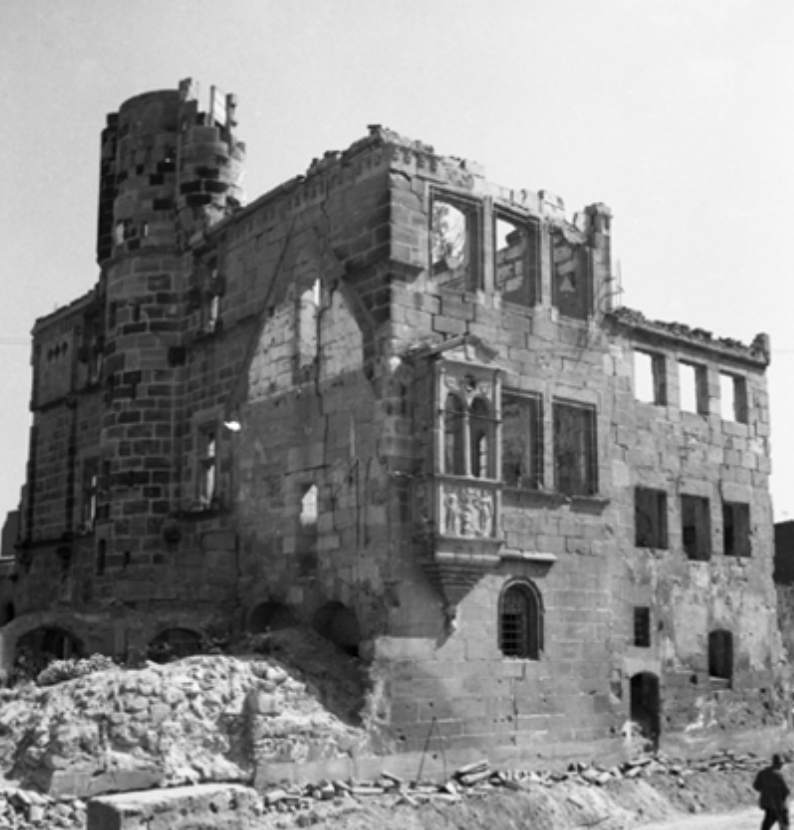
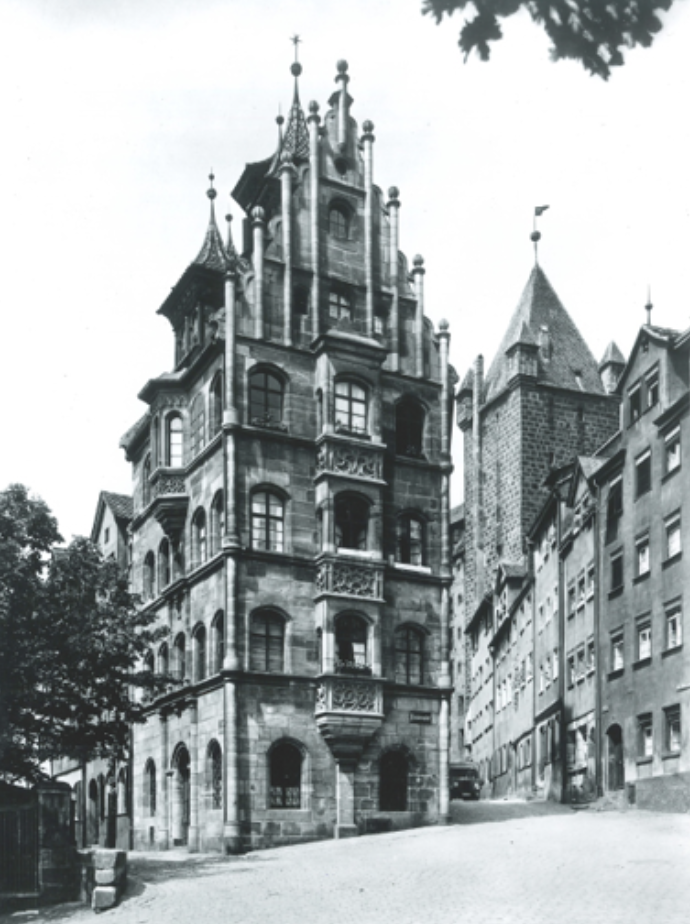
Imperial visits were highlights for the free imperial city. Amid the jubilation and adulation of the burghers, the emperor and his retinue would move in procession to the castle. The high point of the whole spectacle would be reached just about where the Fembo-Haus stands at the final ascent to the castle. Here, an impressive triumphal arch was erected, actually a multi-story structure of wooden scaffolding covered with painted canvas. Such arches were one-off structures built for a single occasion, meaning they have not been preserved, but their appearance was recorded in drawings.
The emperor may have been the nominal head of the free imperial city, but the day-to-day business of actually running the municipality was left to the city council. If you want to find out more about this institution, please proceed to the next room.
CITY MUSEUM AT FEMBO-HAUS
MEDIA GUIDE